SYNDECRETE
In his early twenties, David Hertz began experimenting with concrete as a material for furniture, objects, and architectural applications. At age 23, the year he graduated from SCI-Arc, he had developed Syndecrete, a lightweight, precast, cement-based composite that grew out of those early experiments in design and fabrication. Syndecrete would become both a material innovation and a foundation for David’s work across architecture, furniture, art, and industrial design.
His earliest experiments challenged the conventional perception of concrete as a heavy, coarse building material. He developed a mix that eliminated conventional steel reinforcement, incorporated recycled waste materials, and could be cast, shaped, and finished with a degree of refinement uncommon to concrete at the time. David’s first business card was itself cast in concrete, and he initially sought clients who would commission objects such as chairs and countertops. A line of cone-shaped concrete vases proved so popular at a Los Angeles flower shop that the vases reportedly began outselling the flowers.
What began as experimentation evolved into Syndesis, the multidisciplinary design and fabrication company through which David developed architectural services, custom fabrication, furniture, and household objects. Syndesis ultimately became both a laboratory for developing Syndecrete and a means of integrating the material directly into architectural projects.
A Material Designed Around Waste
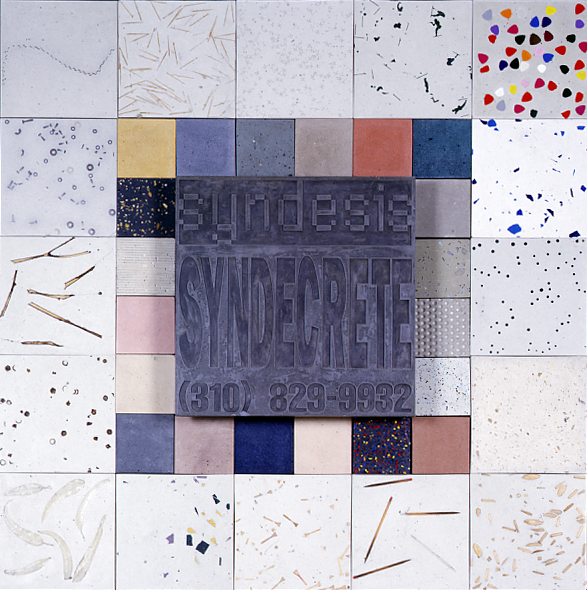
Syndecrete was developed as an environmentally responsible alternative to conventional concrete and petroleum-based solid-surface materials. The composite uses natural minerals, recycled and industrial waste materials (including carpet fiber and fly ash), and aggregates such as crushed glass, wood chips, metal shavings, buttons, shells, stone fragments, and other materials recovered from waste streams.
At less than half the weight of conventional concrete while achieving approximately twice its compressive strength, Syndecrete offered unusual flexibility for a cement-based material. It could also be worked using conventional woodworking tools, allowing it to be cut, drilled, shaped, and installed in ways that expand its usefulness beyond traditional precast concrete.
Over decades of experimentation, hundreds of colors and thousands of customized mix designs were developed, allowing recycled materials to become part of both the performance and visual identity of the finished surface.
From Furniture to Architecture
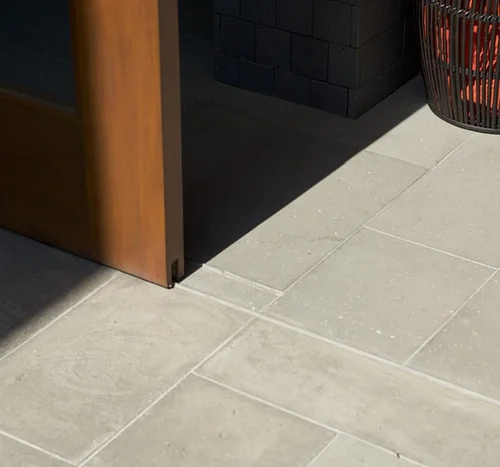
David treated Syndecrete not simply as a product, but as a material that could operate across scales. He designed furniture and custom pieces for residential and commercial clients, produced decorative and sculptural objects for private and public settings, and incorporated Syndecrete directly into buildings and interiors. Applications ranged from furniture, desks, and tabletops to flooring, wall panels, countertops, fireplace surrounds, sinks, bathtubs, showers, fountains, benches, planters, landscape elements, and signage. That breadth allowed the same material language to move from an individual object to an interior installation and ultimately to architecture itself. Syndecrete was used in both residential and commercial projects and specified by architects and designers beyond David’s own practice.
Its applications eventually included projects for Patagonia, Rhino Records, Sony, Nike, The Gap, REI, Virgin Records, Walt Disney Imagineering, UCLA, SCI-Arc, the LAX Control Tower, the National Building Museum, and numerous residential clients, among many others.
Rhino Records & Patagonia
One of the most expressive examples of Syndecrete’s ability to transform waste into architecture was created for Rhino Records following the Los Angeles riots.
Working with the South Central Gang Intervention Program, discarded records, VCRs, CDs, DVDs, and other obsolete media were broken apart and incorporated into a custom Syndecrete mixture. Once the finished material was ground and polished, fragments of record labels, gears, plastic, and other components became visible within the surface.
The material was installed as flooring in Rhino Records’ corporate offices, allowing the company’s own discarded products to become part of its physical environment. What might otherwise have entered the landfill became both an architectural finish and an expression of Rhino’s identity, combining environmental reuse with a socially engaged fabrication process.
This approach, incorporating materials directly associated with a company or institution, became a recurring feature of Syndecrete. The product documentation describes recycled albums embedded in flooring for Rhino Records, Swatch watches cast into retail tiles, and electrical components incorporated into wall panels for Sony.
For Patagonia’s Tokyo store, David applied the same idea to the company’s manufacturing waste. Factory-reject zippers and broken buttons were incorporated into Syndecrete flooring, transforming discarded production material into visible aggregate within the architecture. Rather than disguising recycled content, Syndecrete made it part of the material's character. Waste could carry a story about its origin and, in projects such as Rhino Records and Patagonia, create a surface uniquely connected to the client.
An Early Model for Circular Design
Syndecrete emerged decades before terms such as circular design and material upcycling became common within architecture. Its underlying premise was straightforward: materials considered waste could instead become feedstock for a new, durable product.
The Syndecrete process incorporated both industrial and post-consumer waste, including discarded carpet fiber and fly ash, and was described as a low-embodied-energy material with a high percentage of recycled content. For David, however, sustainability was never solely a technical specification. The waste itself could become part of the aesthetic. Glass, metal, electronics, records, buttons, wood, shells, and other fragments could remain visible within the finished material, giving each application its own texture, history, and identity. Over the following decades, Syndecrete was used in high-profile residential, commercial, cultural, and institutional projects and received extensive international attention in architecture and design publications.
From an experimental concrete chair and a cast business card to furniture, public installations, interiors, and entire architectural surfaces, Syndecrete became an early expression of an idea that has continued throughout David’s career: design can transform waste into a resource while creating objects and places that are useful, durable, and beautiful.